

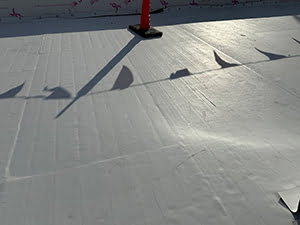
Commercial roofing service is a broad term that can include inspection, maintenance, repair, restoration, coating, replacement, and urgent response work. The useful question for a building owner is not simply which service exists, but which one fits the roof’s actual condition and the building’s priorities. Shark Commercial Roofing Systems works with commercial property owners across its approved Southern California service area. Call (213) 466-0074 to discuss an assessment.
Different Aspects of a Commercial Roofing Service
Each type of roofing service addresses a different condition. A written recommendation should explain what problem the proposed service is meant to solve, what evidence supports it, and what it will not correct.
| Service | What It Addresses | Important Limitations |
|---|---|---|
| Inspection and assessment | Documents roof condition, visible defects, drainage, flashing, moisture concerns, and areas that need further investigation. | An inspection identifies evidence and priorities. It does not make every repair, coating, or replacement recommendation automatic. |
| Maintenance | Provides planned checks and upkeep intended to identify developing issues and keep roof details functioning as intended. | Maintenance does not reverse deterioration or concealed damage that has already occurred. |
| Repair | Addresses defined defects such as localized leaks, punctures, flashing problems, or damaged details. | A repair should stay tied to the confirmed defect. Repeated or widespread problems may need a broader assessment. |
| Coating or restoration | Can renew or protect a compatible existing roof when condition, moisture, drainage, preparation, and adhesion requirements support the system. | A coating does not correct every drainage problem, saturated insulation, unsuitable substrate, or structural issue. |
| Replacement | Replaces an existing roof assembly when condition, damage extent, project goals, or repeated failures support a larger intervention. | Age alone is not enough to prove replacement is necessary. The scope should follow roof-specific evidence. |
| Emergency response | Helps address active leaks or storm-related conditions that need prompt attention to limit immediate interior exposure. | Emergency work may stabilize the immediate problem, but follow-up assessment can still be needed to define permanent repairs. |
What Building Owners Can Safely Observe
Some conditions are useful to document from safe interior or ground-level locations. Ceiling stains, active dripping, damaged interior finishes, unusual odors, visible debris near drainage areas, or a problem that returns after previous repair are reasons to request professional evaluation. These observations help describe the symptom, but they do not establish the exact roof defect or the extent of concealed moisture.
Building staff should not climb onto the roof to diagnose the problem. Roof-level inspection, moisture investigation, infrared scanning, and repair work require appropriate access, equipment, and training.
How an Assessment Determines the Right Service
A commercial roof assessment should look at the membrane or roof surface, flashing, penetrations, drainage, previous repairs, visible moisture evidence, and the extent of deterioration. Shark’s current assessment capabilities include full-surface infrared scanning and thermal drone inspections with a licensed drone pilot when those methods are appropriate to the project. These tools can add information about roof conditions, but they should support, not replace, roof-specific evaluation and documented findings.
The recommendation should connect the evidence to the proposed action. A contained flashing defect may support a repair. A compatible roof with suitable moisture, drainage, and substrate conditions may be considered for a coating or restoration system. Repeated failures, widespread deterioration, or conditions that cannot be reasonably addressed through repair or restoration may justify discussing commercial roof replacement.
When to Take Action
Routine inspection frequency should follow the roof system, manufacturer or warranty requirements, building use, exposure, prior repair history, and any known drainage or rooftop-traffic concerns. There is no single calendar interval that fits every commercial roof.
Active leaks, storm damage, rapidly changing interior symptoms, or water near electrical equipment deserve prompt attention. Less urgent conditions, such as recurring minor repairs or drainage concerns, should still be documented and included in planned commercial roof maintenance or inspection rather than ignored until the next major failure.
Choosing the Next Commercial Roofing Service
The practical decision is to match the next step to documented roof conditions instead of starting with a preferred service. If the problem is isolated, commercial roof repair may be appropriate. If the roof is a viable restoration candidate, a coating system can be evaluated. If deterioration or project requirements point beyond repair or restoration, replacement can be compared with those alternatives using the same condition evidence.
Shark Commercial Roofing Systems can assess commercial roofs across its service area and explain the findings before a scope is approved. Call (213) 466-0074 or use the contact page to discuss the building and the next assessment step.
Frequently Asked Questions
How do I know which commercial roofing service my building needs?
Start with a roof-specific assessment. The condition, damage extent, moisture concerns, drainage, previous repairs, and building goals should support the recommendation.
Does an active leak always mean the roof needs replacement?
No. A leak may come from a localized repairable defect, but recurring or widespread conditions can justify a broader assessment before more repair work is approved.
Can every commercial roof be restored with a coating?
No. Coating suitability depends on the existing roof, moisture, drainage, substrate condition, compatibility, preparation requirements, and the selected system.
When should emergency roofing service be followed by another inspection?
When emergency work stabilizes an active leak or storm-related condition, follow-up assessment can help identify the underlying cause and define any permanent repair or broader work still needed.