

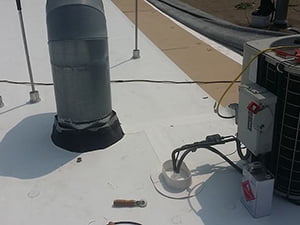
Deciding between commercial roof repair and replacement affects your budget, your operations and how long your building stays protected. Shark Commercial Roofing Systems works with commercial property owners on both, and the useful question is usually narrower than “repair or replace”: is the problem a localized defect that a repair can correct, or is it a sign of damage that calls for a broader assessment of the whole roof?
A visible symptom alone rarely answers that. A stain, a drip or a puddle shows where water showed up, not where it got in or how far it has traveled. This guide explains what repair and replacement each involve, which evidence helps separate a localized defect from widespread damage, what a repair quote should include and when replacement becomes the sensible choice.
What is Commercial Roof Repair?
Commercial roof repair corrects specific defects so the roof can keep protecting the building. Typical work includes resealing or rebonding open seams, replacing damaged flashing, repairing punctures and failed membrane areas, and correcting drainage problems that let water stand. Shark’s commercial roof repair services start with an evaluation of the roof so the repair addresses the actual source of the problem.
Repair can extend the service life of a roof that is otherwise sound, and it can delay a larger expense. It has limits, though. A repair fixes the defect it targets and does not restore a roof whose membrane, insulation or deck is deteriorating across large areas.
What is Commercial Roof Replacement?

Commercial roof replacement involves installing a new roof system over a defined roof area, with removal of existing materials or an overlay approach determined by the roof condition, applicable requirements and project scope. It is appropriate when the roof is damaged beyond reasonable repair, has reached the end of its useful life or can no longer be made watertight by patching. Replacement involves a larger upfront investment than repair, and it can be a better value when repairs are becoming frequent. Shark’s commercial roof replacement page describes that work.
Between the two sits restoration. When a roof is still sound underneath, a coating system can be an option instead of tear-off. It is only suitable when moisture, adhesion, substrate and drainage checks support it, which is covered in Shark’s page on acrylic roof coating details.
Factors Influencing the Decision
Commercial roofs deal with sun, rain, foot traffic and equipment over many years. When problems appear, these factors help frame the choice:
- Extent of damage: Isolated leaks and short seam failures are often repairable. Damage spread across the roof, or moisture trapped in the insulation, points toward a broader assessment.
- Age and condition of the roof: Older roofs can reach a point where each repair holds only briefly. Condition matters more than age alone, so the findings on the roof should carry more weight than the calendar.
- Repair history: Repeated repairs in different places suggest the roof as a whole is wearing out.
- Cost over time: Compare the cost of continuing repairs, the disruption they cause and the remaining useful life against the cost and timing of a larger project.
- Business impact: Interior leaks can affect inventory, equipment and tenants, so the cost of waiting belongs in the comparison.
Repair Evidence and the Limits of Localized Repair
Good decisions come from evidence collected on the roof. The table below shows how common symptoms connect to inspection findings and what each finding means for the choice between a localized repair and a wider assessment.
| What you notice | What inspection evidence should confirm | A localized repair may fit when | A broader assessment is needed when |
|---|---|---|---|
| Open or separating seams | Length and location of the open seam, condition of the membrane on both sides and whether the seam failed from movement or age | The failure is short, the surrounding membrane is sound and the seam can be rebonded or sealed | Seams are failing in many places or the membrane next to them is brittle or shrinking |
| Penetrations such as vents, pipes and curbs | Condition of the sealant, boots and base flashing around each penetration | One or two penetrations show a clear, correctable defect | Many penetrations are failing together or the surrounding membrane is damaged |
| Flashing and edge details | Whether flashing is loose, cracked or pulling away, and the condition of the wall, parapet or edge behind it | Damage is limited to one detail and the attachment behind it is sound | Flashing has failed along long runs or the parapet or edge it attaches to is deteriorating |
| Ponding water | Where water stands, how long it stays after rain and whether drains and scuppers are clear | A blocked drain or small low spot explains it and can be corrected | Ponding is persistent across a wide area, which points to slope, structure or drainage design |
| Leaks and interior stains | The path of water from the roof, a moisture survey of the roof system and a direct check of the flagged areas | Moisture is limited to a small area with a clear source that can be repaired | Moisture is widespread or the source cannot be traced to a single defect |
Moisture screening is often part of this evidence. Shark’s evaluations can include full-surface infrared scanning by a licensed drone pilot, depending on the property and the question being answered. A thermal anomaly is an indicator that points to where to look, not proof of wet insulation, so flagged areas still need a direct check. Likewise, an interior stain does not prove how much of the roof is damaged, and it should not be used by itself to decide for or against replacement.
What a Repair Quote Should Include
When you compare repair proposals, look at what each one covers. A useful quote lists the specific areas to be repaired, the defect found at each one, the materials and method, how the repair connects to the surrounding roof, and what is excluded. It should also say how related issues will be handled if they turn up during the work, such as wet insulation under a repaired area or deteriorated material beyond the original scope.
Ask how the repair will be checked when the work is finished and what documentation you will receive. A quote that names only a total with no scope makes it hard to compare options or to tell later whether the work addressed the cause of the problem.
The Importance of Timely Commercial Roof Repair
Water that enters a roof does not stay where it entered. It can spread through insulation, damage the deck and reach the interior, so a small defect left alone often becomes a larger one. Acting on early signs gives you more options, including a localized repair, and it usually shortens the time the building is exposed.
Regular inspections and upkeep also help catch problems before they cause interior damage. Shark’s maintenance services are one way to keep a roof watched between repairs, and drainage solutions address standing water that repairs alone will not stop.
Access Planning and Safety
Roof work on an occupied commercial building needs planning. Before work starts, agree on roof access, where materials will be staged, how tenants and the public will be kept clear, and what protection will cover interior areas, equipment and entrances below the work. Owners should not walk a roof themselves to look for the source of a leak. Photographs from the ground or interior, notes on when the problem appears and a record of past repairs are safe ways to help the evaluation.
When is Commercial Roof Replacement Inevitable?
Repairs stop being a sound strategy when damage is widespread, moisture is found across large areas of the roof system, the membrane has aged past the point where it can be repaired reliably, or the roof cannot be made compatible with a restoration option. Replacement is also worth a serious look when repair costs and interruptions keep adding up and the remaining life of the roof is short.
Recognizing that point early lets you plan the project, budget for it and schedule the work, rather than reacting to an emergency. A roofing professional can compare the findings, the repair history and the options so the choice rests on the condition of your roof.
Reach Out to Shark Commercial Roofing Systems
Shark Commercial Roofing Systems has been in business since 1983 and helps commercial property owners weigh repair, coating, maintenance and replacement. To talk through your roof’s condition, call (213) 466-0074 or contact us to arrange an evaluation.
Frequently Asked Questions
Can a roof stain or leak tell me whether I need replacement?
No. A stain shows where water appeared, not where it entered or how far it traveled. Inspection and moisture findings are needed before choosing a repair or a wider assessment.
When can a commercial roof be repaired instead of replaced?
Repair often fits when damage is localized, the surrounding membrane is sound and the cause is a clear, correctable defect such as a failed seam, flashing detail or blocked drain.
What should a roof repair quote list?
The specific areas, the defect at each one, the materials and method, what is excluded, how related issues will be handled and how the finished work will be checked.
When is a wider roof assessment the better step?
When seams or flashing fail in many places, ponding is persistent, moisture is widespread or repairs keep recurring, a broader assessment helps determine whether repair, restoration or replacement is the sound choice.