

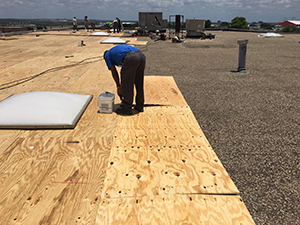
For Shark Commercial Roofing Systems, commercial flat roof repair in Los Angeles begins with a $650 minimum charge. Above that minimum, Shark budgets repairs at $0.95 to $6.50 per square foot of the area actually being repaired, so the price follows the size of the repair and the conditions found there, not the size of the whole roof.
That is why there is no universal total for a commercial roof repair. A failed seam and wet insulation can be associated with similar interior symptoms, yet they lead to very different scopes. This guide is written for building owners, facility managers, operations managers and property managers who are reviewing a repair proposal and want to know what changes the price and what the written proposal should clarify.
Costs can vary depending on whether insulation is wet, decking repairs are necessary, special permits are involved, special access equipment is needed, and other project-specific conditions. The figures in this guide are Shark budget guidance as of October 2026. They are not market averages and they are not a quote.
- Minimum: $650 minimum charge for a commercial roof repair.
- Repair rate: $0.95 to $6.50 per square foot of the area being repaired, subject to the minimum.
- System figures: coating, TPO, spray polyurethane foam and modified-bitumen figures describe different project scopes and are not repair rates.
What a Commercial Roof Repair Estimate Needs to Define
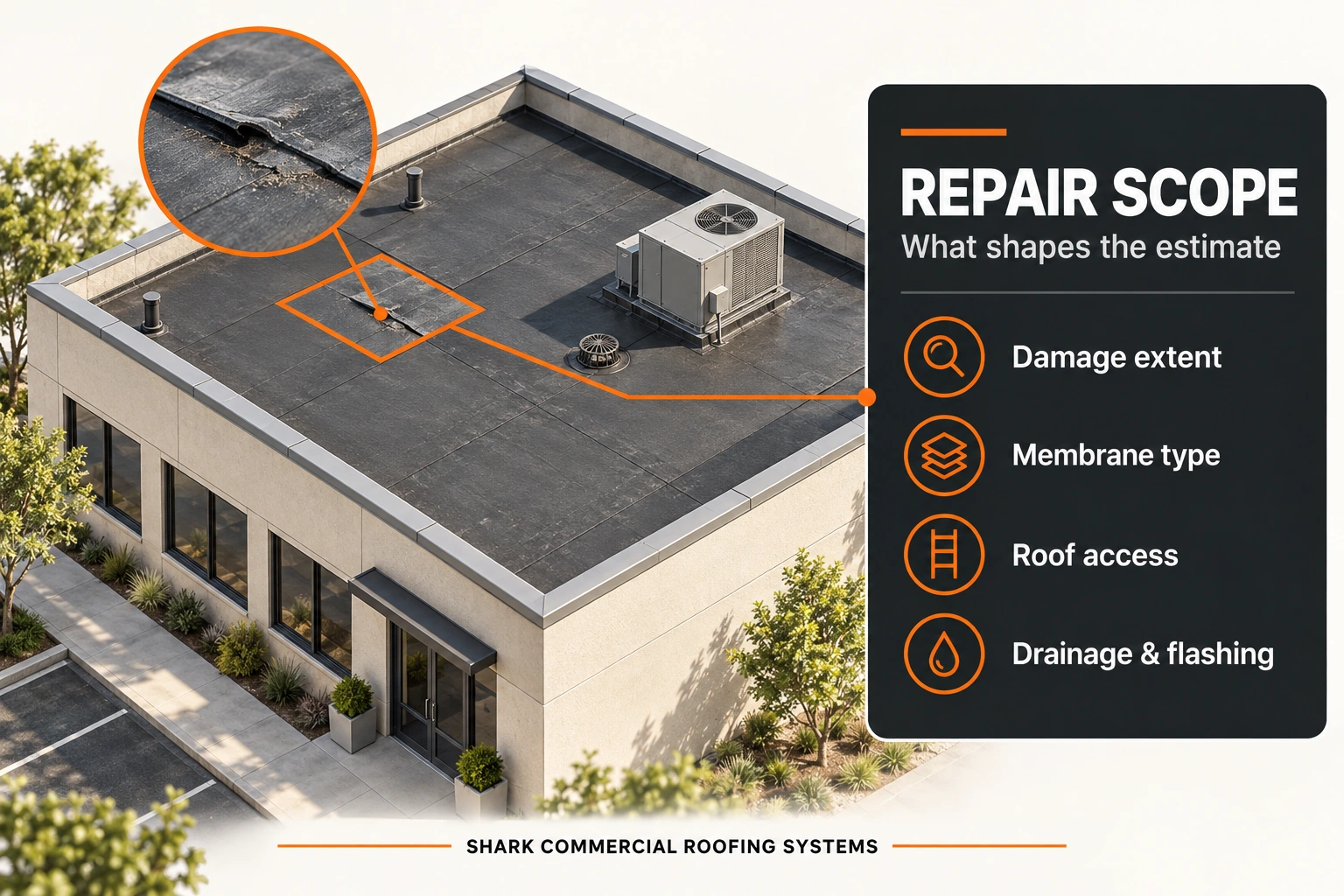
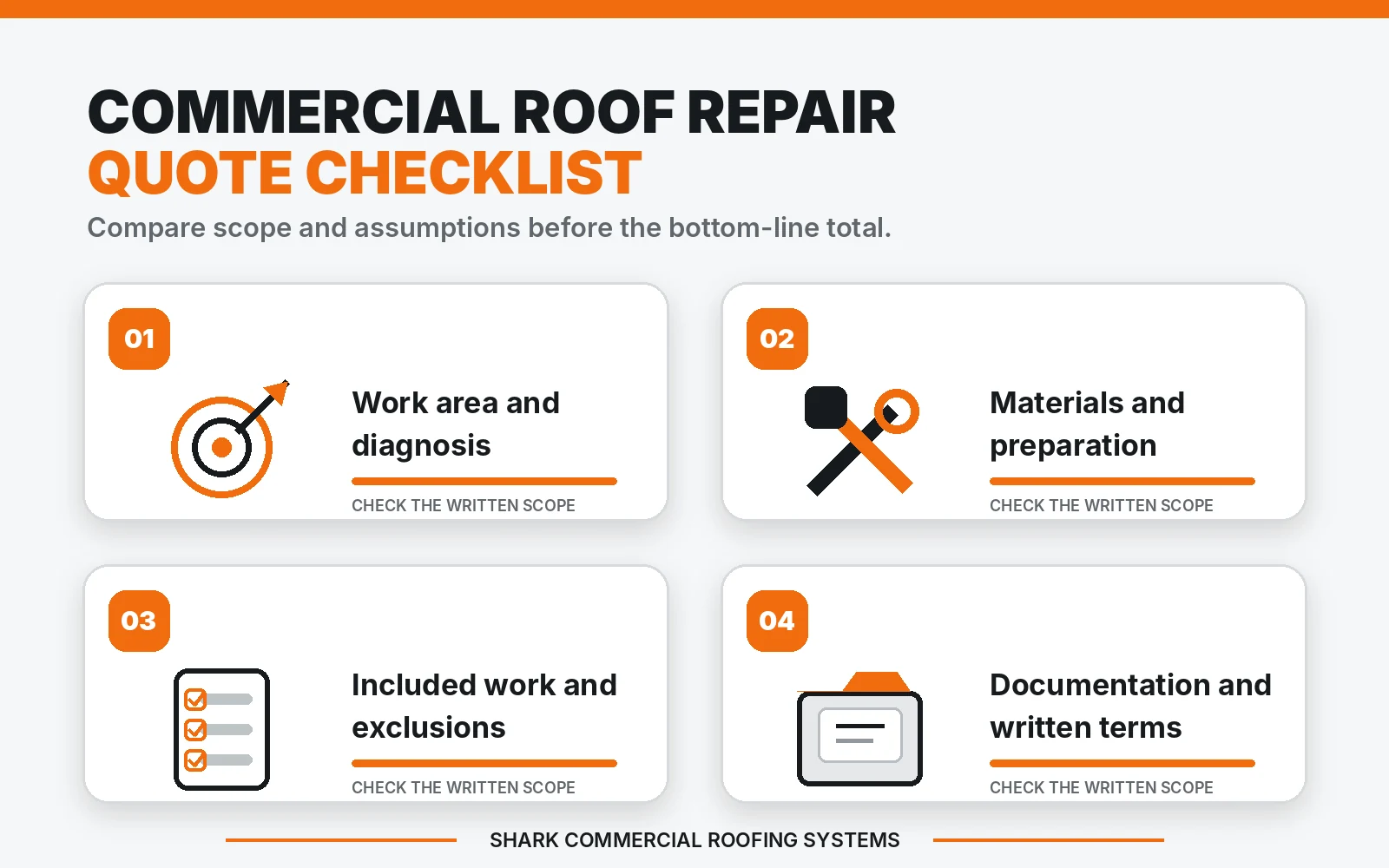
A repair price only means something when the work behind it is defined. Before any number is set, a proposal should identify the work area and the defect observed there: where it is on the roof, how large the repaired area is, and what is wrong with it. Water may travel within a roof assembly before becoming visible inside, so an interior stain may not identify the entry point or show how far moisture has spread.
Evidence comes next. The scope should rest on what was found at seams, penetrations, flashing and the surrounding membrane, along with what is known about moisture below the surface. Useful documentation may include dated photos, marked defect locations and notes explaining what was observed, what remains uncertain and what further investigation is recommended.
The existing roof material matters too. A repair has to be compatible with what is already on the roof, whether that is a single-ply membrane such as TPO or EPDM, modified bitumen, or a previously coated surface. The proposal should name the repair method and explain why it suits the existing system. Our commercial roof repair service page describes the repair approach when that is the right fit for the existing roof.
Proposals should also say how the crew will prepare the area, reach it, protect the occupied building below and document the finished work. Treat these as questions to ask, not as items every proposal automatically includes. Where it applies, infrared or thermal drone information can help identify roof areas that may warrant further investigation without requiring a crew to walk every square foot. Shark has been in business since 1983, and full-surface infrared scanning by a licensed drone pilot is part of how it evaluates roofs. It is not a promise that every repair visit includes it. Infrared imaging identifies thermal anomalies; direct confirmation is needed before treating an area as wet.
Why Similar Leaks Can Produce Different Repair Quotes
Two roofs with the same leak symptom can end up with quotes that look nothing alike. The differences usually come from the following factors.
Repair Area and Number of Details
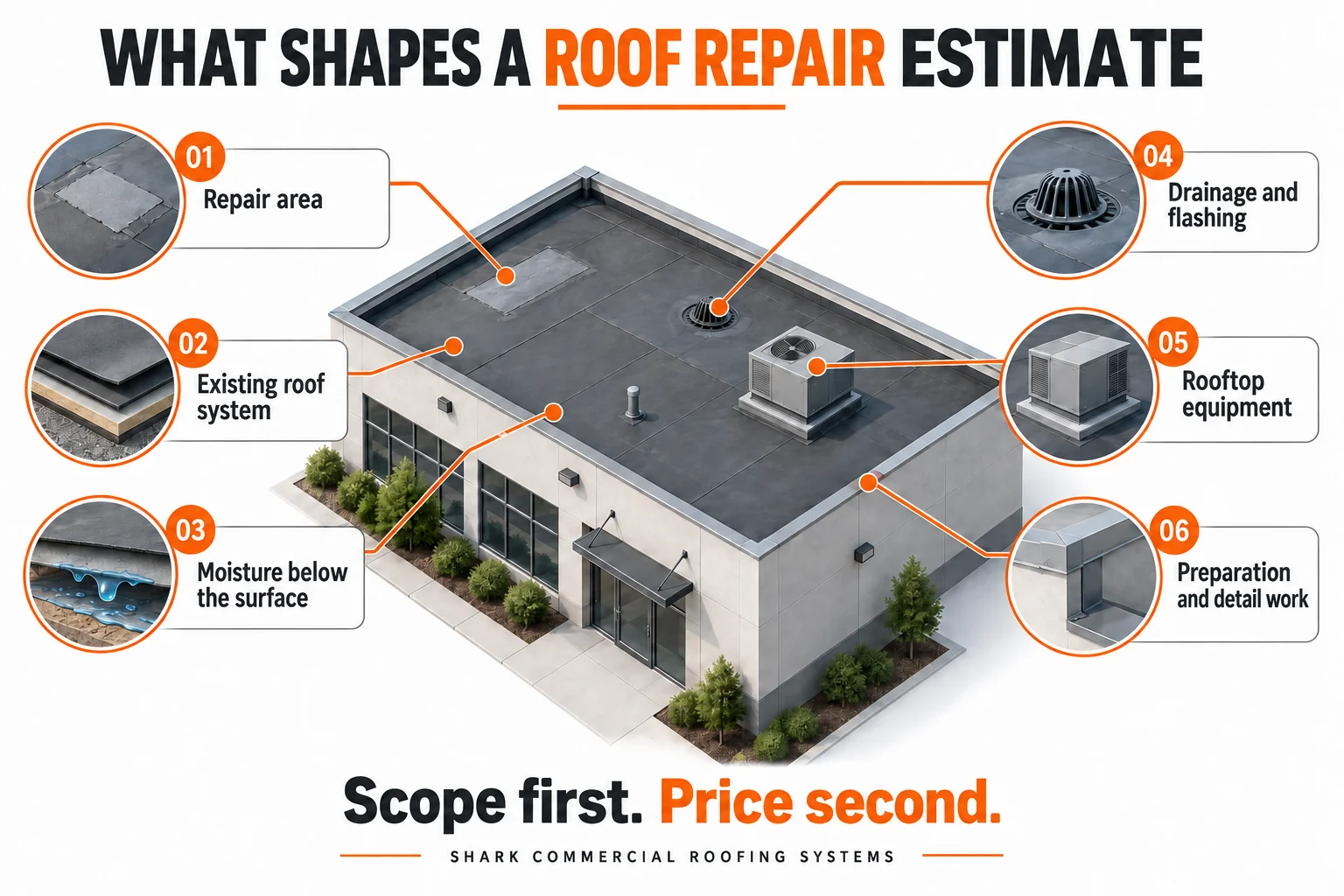
The repaired-area rate applies to the area being repaired, so a 100 square foot repair and a 2,000 square foot repair start from different bases. The number of separate details matters as well. Ten small seam failures spread across a roof take more setup and more individual detail work than one contiguous patch of the same total size.
Existing Roof System and Material Compatibility
Single-ply membranes, modified bitumen, built-up roofs and coated surfaces are repaired differently. The method, the materials and the preparation all follow from the existing system, and a roof with several earlier repairs or layers of coating can be harder to work on than a clean, single-system roof.
Wet Insulation or Concealed Moisture
Moisture trapped below the membrane is one reason a repair scope can grow. If insulation under the repair is wet, patching the surface alone does not address that condition, and the scope may need to include removing and replacing saturated material. Whether insulation is wet may remain uncertain until the roof is tested, which is why the proposal should say what happens to the price if it is found.
Necessary Decking Repairs
If the deck under the roofing is damaged, that condition may need to be corrected before the roofing repair can be completed. Decking condition may not be fully known from surface observation alone, so a proposal should state how deck repairs will be handled if they are discovered once the work begins.
Flashing, Penetrations, Seams, Drainage and Rooftop Equipment
Details are where many roof leaks start. Flashing at walls and edges, seals around pipes and vents, seams between membrane sections, and the connections around rooftop units each need their own attention. Standing water changes the picture too, since a repair at a low spot may fail again unless drainage is addressed. Equipment curbs and drains add work because the crew has to repair around objects that cannot be moved.
Height, Staging, Permits and Operations
Building height and roof access affect how materials and crew reach the work. Special access equipment, special permits and operating constraints, such as working around tenants, business hours or sensitive equipment below, can all change the cost and the schedule. Each one should be named in the proposal if it applies, so it does not appear later as a surprise.
How to Read the Pricing Correctly
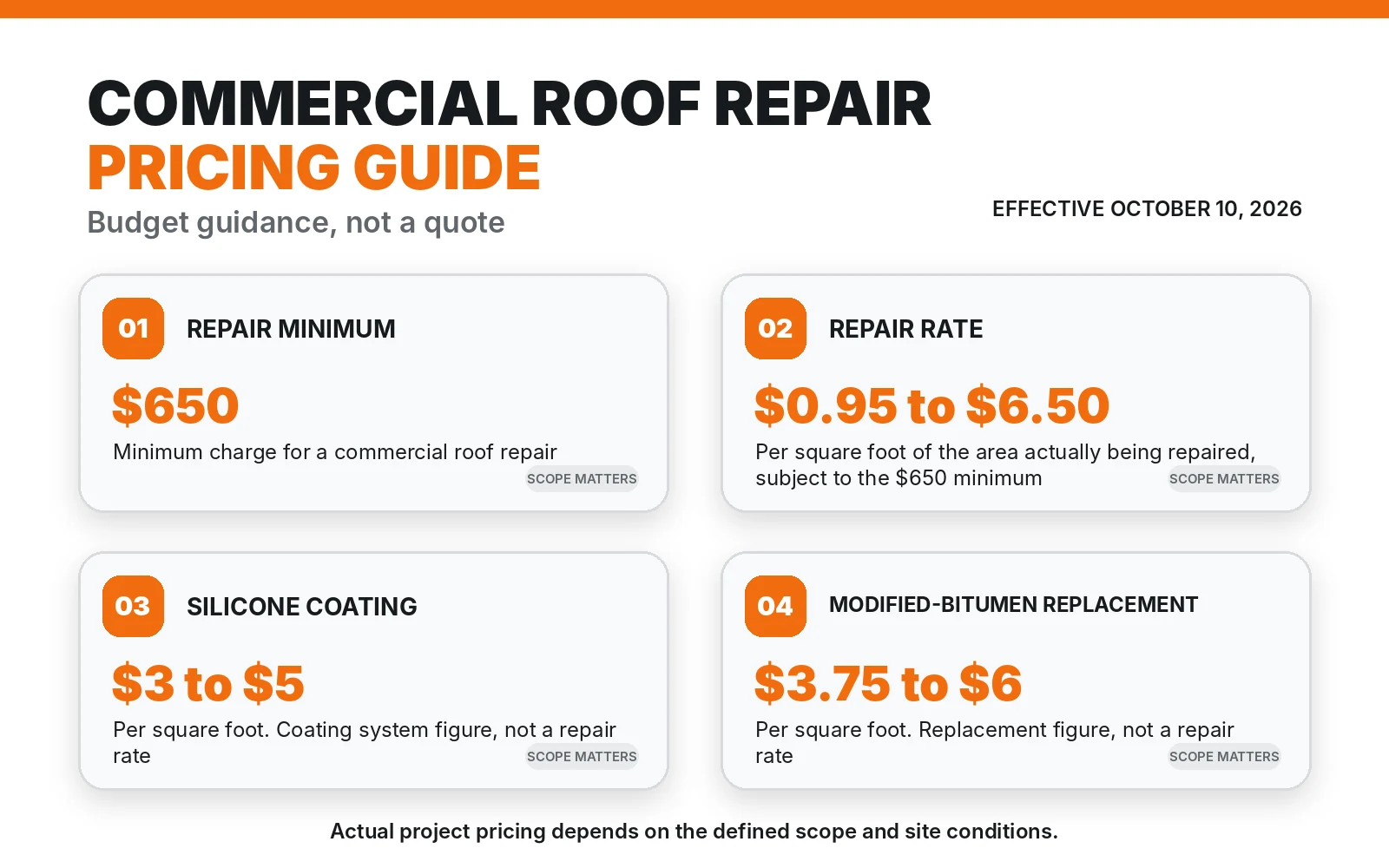
Three numbers are easy to confuse, and mixing them up is the most common way a budget goes wrong. The minimum charge is a floor for a repair: $650. The repaired-area rate is $0.95 to $6.50 per square foot, and it applies only to the area actually being repaired. Total roof area is a different measurement, and it should not be multiplied by the repair rate unless the entire roof is truly the area being repaired.
The other figures in the table are system figures for coating and roofing projects. They describe different scopes at different per-square-foot ranges, and they are not interchangeable with repair rates. Modified bitumen, for example, is a replacement figure, not a repair rate. Exact inclusions are set in the written proposal for the specific project.
| Price item | Budget figure | Basis | Scope boundary or proposal question |
|---|---|---|---|
| Repair minimum | $650 minimum charge | Per commercial roof repair | Applies when the repaired-area calculation comes out lower. Ask what the minimum covers in the written proposal. |
| Repair rate | $0.95 to $6.50 per square foot | Area actually being repaired | This is the only repaired-area rate in the table. It is subject to the $650 minimum and does not apply to total roof area. |
| Silicone coating | $3 to $5 per square foot | Coated roof area | A coating system figure, not a repair rate. Ask what preparation and repairs come first. |
| Acrylic coating | $2.50 to $4 per square foot | Coated roof area | A coating system figure, not a repair rate. Ask whether the roof is a suitable candidate. |
| TPO | $8 to $12 per square foot | Roof area covered by the system | A roofing system figure with a different scope from a repair. |
| Spray polyurethane foam (SPF) | $8 to $12 per square foot | Roof area covered by the system | A roofing system figure with a different scope from a repair. |
| Modified bitumen | $3.75 to $6 per square foot | Roof area being replaced | A replacement figure, not a repair rate. |
Two rate-only budget illustrations show how the minimum and the repaired-area rate work together. They are budget math, not quotes, and they leave out every project condition described above.
- 100 square feet of repaired area. At $0.95 per square foot the arithmetic gives $95, and at $6.50 per square foot it gives $650. Both fall at or below the $650 minimum, so the rate-only budget is $650.
- 400 square feet of repaired area. At $0.95 per square foot the arithmetic gives $380, which is below the minimum, so the low end is $650. At $6.50 per square foot it gives $2,600. The rate-only budget runs from $650 to $2,600.
A rate-only calculation does not capture wet insulation, decking repairs, permits, access equipment or the other conditions listed earlier, which is why a written proposal based on the actual roof is the only reliable number.
Three Illustrative Repair Scopes
These are hypothetical scope patterns to show how the same budget guidance leads to different proposals. They are not Shark projects, invoices or promised outcomes.
Pattern one: an isolated defect. A single failed seam, a punctured section of membrane or a short run of loose flashing, with dry surroundings. The repaired area is small and contained, so the minimum charge often shapes the budget.
Pattern two: repeated detail failures. Several penetrations or roof sections show similar failures, such as worn seals around pipes and vents or seams opening in more than one place. The total repaired area grows, and the proposal needs to decide whether each detail is repaired individually or whether the pattern calls for a broader scope.
Pattern three: suspected wet insulation or decking. Ceiling stains, soft spots or thermal scan results suggest moisture beneath the membrane. Until that is confirmed, the repair scope is provisional, and the proposal should explain how the work will change if insulation or decking is involved.
| Observed condition | Evidence needed before scope is set | What may expand the work | What the proposal should clarify |
|---|---|---|---|
| Isolated seam, flashing, puncture or localized membrane defect | Seam condition along its full length, flashing attachment, and evidence that surrounding materials remain suitable for repair | Additional failed sections found along the same seam or flashing run | The repaired area, the repair method, and what happens if more is found |
| Repeated failures at several penetrations or roof sections | Condition of each penetration seal and the membrane around it, plus seam condition across the affected sections | A larger repaired area, or a decision that the pattern needs a broader assessment | How many details are included, whether each is itemized, and how additional details are priced |
| Suspected wet insulation or decking involvement | Moisture findings and how they were confirmed, such as a direct check after a thermal scan flags a suspect area | Removing and replacing wet insulation, repairing the deck, or moving to a broader roofing project | How moisture and decking contingencies are handled, and when the owner is told before work continues |
When Repair Fits and When the Scope May Need to Expand
A localized repair may be appropriate when the evidence shows a defect confined to a limited area, the surrounding roof remains serviceable and moisture has not spread beyond the proposed repair area. In that case a targeted repair can be a sensible answer to a specific problem.
The scope may need to expand when moisture has spread beyond the entry point, when the same type of failure keeps showing up in different areas, or when repairs keep returning to the same spot. Roof age alone is not the deciding factor, and no single percentage settles it. Condition, moisture and repair history do. Depending on what the inspection finds, the next step may be a localized repair, an evaluation of whether coating or restoration suits the roof, or a replacement assessment. Our guide on when commercial roof replacement is necessary covers that last case, and our overview of what affects commercial roofing costs in Los Angeles covers project-level cost factors for repair, restoration and replacement alike.
Maintenance and inspection records can also make future repair decisions easier because they show how a roof has changed over time.
How to Compare Repair Proposals
When two repair proposals arrive with different totals, the first task is to confirm they describe the same work. The worksheet below lists what each proposal should define, and a facility manager and roofing representative can use it together to find the gaps. If an item is missing from one proposal, it is a question to resolve before the prices can be compared.
| Proposal item | Where it should be defined | Question to resolve if unclear |
|---|---|---|
| Work area | Scope of work, with the repaired area measured or marked | What exact area is being repaired, and how was it measured? |
| Condition evidence | Inspection findings, photos and defect locations | What evidence supports the scope, and was moisture confirmed or only suspected? |
| Repair method and material compatibility | Description of the repair method and materials | Is the method compatible with the existing roof system, and why was it chosen? |
| Preparation and protection | Preparation steps and protection of the occupied building | How will the area be prepared, and how will tenants and equipment below be protected? |
| Moisture and decking contingencies | Allowances or conditions for wet insulation and deck repair | What happens to the price and schedule if wet insulation or damaged decking is found? |
| Permits and access equipment | Notes on permits and any special access equipment | Are permits or special access equipment needed, and are they included or excluded? |
| Exclusions and change-order process | Stated exclusions and how scope changes are approved | What is not covered, and how are additions priced and approved? |
| Completion documentation | Description of the records provided at completion | What photos or records will be provided when the work is finished? |
| Written terms | The signed agreement or proposal terms | What terms apply to payment, schedule and the work itself, and are they in writing? |
The lowest bottom-line number is only comparable when the scopes match. A lower price may leave out the moisture contingency, exclude access equipment or cover a smaller area, while a higher price may include items the lower one leaves for later. Comparing the worksheet rows first, then the totals, is the way to tell which difference is real.
A Helpful Next Step
If you are reviewing a repair proposal for a commercial flat roof in Los Angeles, Shark Commercial Roofing Systems can walk through the scope with you, explain what was found on the roof and clarify what the proposal does and does not cover. Call (213) 466-0074 to talk through your roof and the scope a repair would need.
Frequently Asked Questions
What is Shark’s minimum commercial roof repair charge?
Shark’s minimum charge for a commercial roof repair is $650. It applies when the repaired-area calculation comes out lower than that amount. What the minimum covers should be confirmed in the written proposal for your roof.
Why is a square-foot rate not the whole estimate?
The $0.95 to $6.50 rate applies only to the area being repaired, and it does not account for wet insulation, decking repairs, permits, special access equipment or other project-specific conditions. Those can change the scope and the price.
When can hidden moisture change the repair scope?
When the insulation or deck under the membrane is wet, patching the surface does not solve the problem. The scope may need to include replacing saturated material, which is why a proposal should say how moisture findings will be handled.
Can a localized repair be appropriate instead of a larger roofing project?
Yes, when the evidence shows a defect confined to a limited area on an otherwise sound roof. If moisture has spread or the same failure keeps recurring, a broader assessment is the better next step.