

For many commercial owners in Culver City, the question is not whether the roof is tired but how much work it actually needs. Silicone roof coating is a fluid-applied membrane that can renew the waterproofing on a flat or low-slope roof without removing what is already there. Shark Commercial Roofing Systems is headquartered in Van Nuys and has worked in commercial roofing since 1983, so the budget question below comes up often.
The short version: coating usually costs less than replacement when the roof underneath is still sound, and it stops being a bargain when it is not. The sections that follow explain how to tell which situation a building is in, so an owner can compare options on evidence instead of price alone. To talk through a specific property, call (213) 466-0074.
Where the Savings Actually Come From
A fair comparison looks at every line of the project, not only the price of the material. Most of the difference between coating and replacement comes from work that coating avoids, and from work that neither option can skip.
| Budget line | Coating path | Replacement path |
|---|---|---|
| Removing the old roof | None when the existing roof stays in place | Tear-off, hauling and disposal of the old materials |
| Preparation | Cleaning, seam reinforcement and repairs to damaged areas before application | Deck repairs and any substrate work the tear-off uncovers |
| New materials | A fluid-applied silicone layer, applied in the layers the manufacturer specifies | A complete new membrane, insulation and flashings |
| Disruption to occupants | Typically shorter, with less noise and debris | Typically longer, with more debris and rooftop activity |
| Later in the roof’s life | Periodic cleaning, inspection and eventually a recoat | A new roof that starts its own maintenance cycle |
| What can change the picture | Wet insulation, a failing deck, or widespread damage that makes coating the wrong tool | Nothing hidden is left behind, but the budget is larger up front |
The last row deserves attention. A coating that is applied over a hidden problem does not save money. It postpones the cost and can make it larger.
Roof Conditions That Favor a Coating
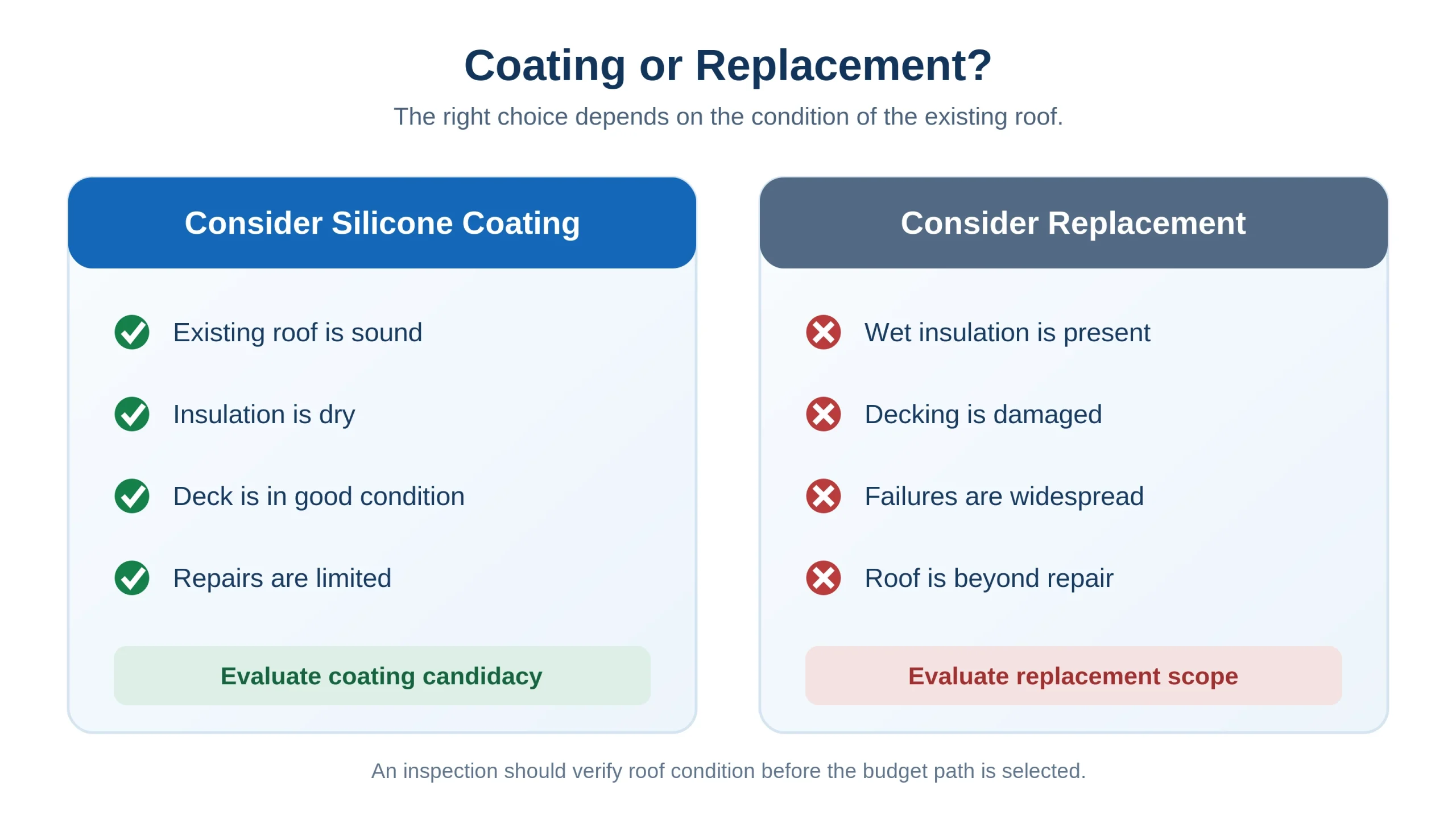
Coating works best on roofs that have aged but not failed. Several conditions tend to point the right way:
- A limited repair footprint. When only a small share of the roof needs repair before coating, the economics hold. When most of it does, a new roof often makes more sense.
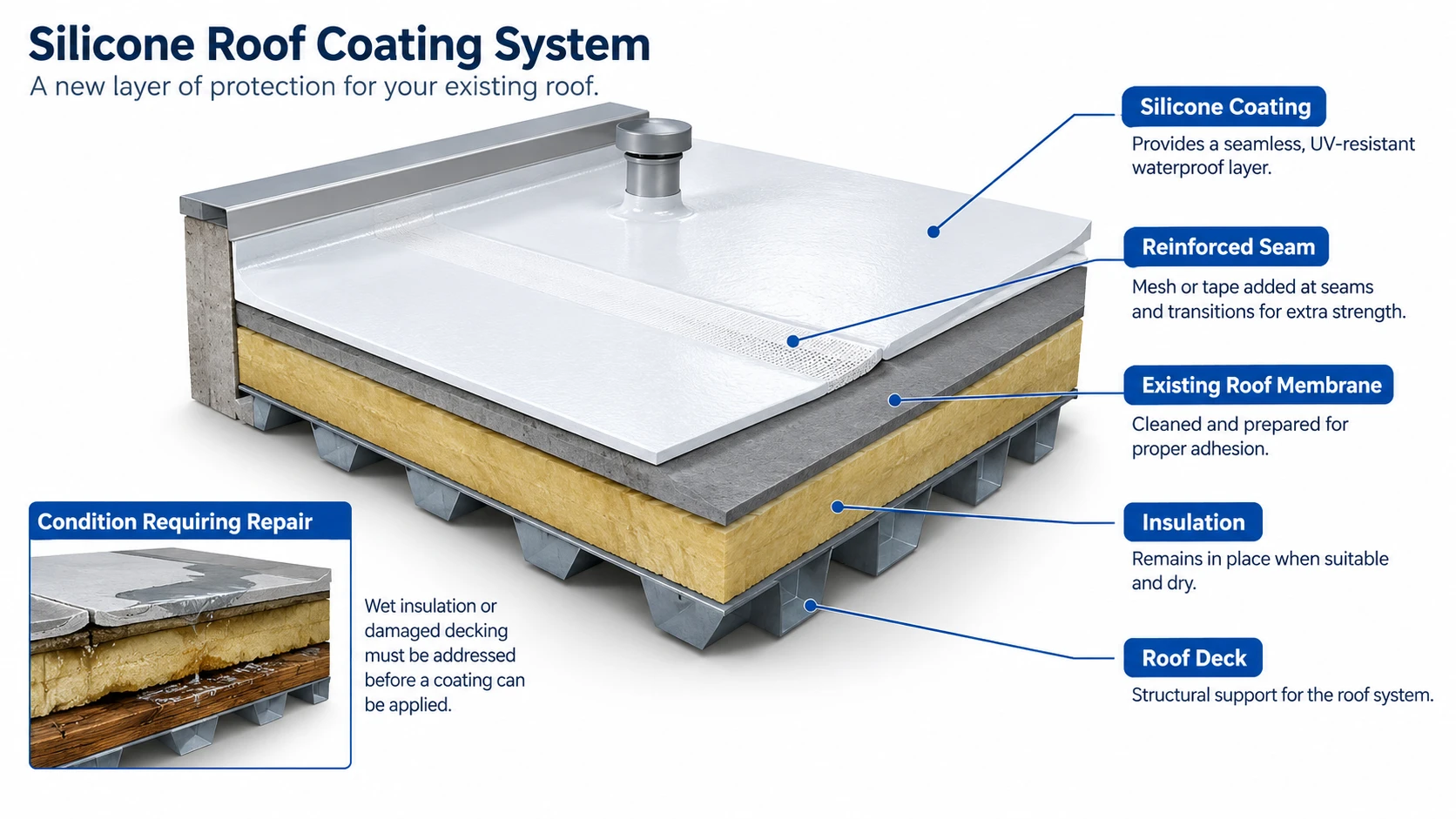
- Dry insulation and a sound deck. Damaged decking has to be replaced, and saturated insulation holds moisture under the coating.
- Existing membranes that accept coating. Modified bitumen and many single-ply roofs can be cleaned, repaired and coated when adhesion is confirmed.
- Manageable drainage. Silicone is often chosen where water stays on the surface longer than it should, but ponding still deserves a cause. Our overview of roof drainage explains why.
- Seams and penetrations that can be reinforced. Seams are typically reinforced with mesh or tape, and curbs, vents and equipment supports are detailed before the coating goes on.
How Silicone Performs After Application
Silicone cures into a seamless, flexible surface that resists ultraviolet exposure well, which matters on roofs that see strong sun for much of the year. A reflective finish can reduce the heat a roof absorbs, which may lower cooling demand. It does not add insulation value, so a building that needs better thermal performance has to address that separately.
Owners should also know the trade-offs. Silicone tends to hold onto dirt, so the surface can darken and may need periodic cleaning to keep its reflectivity. The cured surface can be slippery when wet or dusty, which matters for crews and for anyone servicing rooftop equipment, particularly on steeper roofs. Neither point rules silicone out, but both belong in the maintenance plan. If silicone is not the right fit, an acrylic coating system is the other coating option Shark applies, with its own strengths and limits.
What to Ask for Before Approving the Work
A coating proposal should show its reasoning. These items turn a price into something an owner can compare:
| Evidence to request | Why it matters to the budget |
|---|---|
| Infrared scan results with confirmed moisture locations | Wet insulation can change the scope and cost after work begins |
| Repair scope, measured against the whole roof | Our silicone page treats roofs needing repair on less than about a quarter of their area as coating candidates, so the proportion drives the decision |
| Written coating specification | Layer count and thickness follow the manufacturer, so a proposal should name the system and what it requires |
| Drainage notes | Water that lingers after rain affects which coating works and how long it lasts |
| Maintenance requirements | Warranties generally depend on upkeep and inspection, so the plan is part of the true cost |
Keep in mind that a coating is a maintenance commitment. Scheduling regular roof inspections and upkeep is how an owner protects the investment and keeps warranty conditions intact.
When Replacement Is the Better Budget Decision
Some roofs have passed the point where coating makes financial sense. Widespread saturated insulation, a deck that no longer holds fasteners, or repeated failures in the same areas all point toward commercial roof replacement. In those cases, spending on a coating adds cost without solving the underlying problem, and replacement lets the whole assembly, including insulation and drainage, be redesigned at once.
Tax treatment is another place owners sometimes hope to find savings. Whether any roofing work qualifies for a deduction or credit depends on the project and the owner’s situation, so it is a question for a qualified tax professional rather than an assumption to build the budget around.
Silicone Roof Coating for Culver City Properties
Shark evaluates commercial flat and low-slope roofs in Culver City and across the Los Angeles area, and recommendations follow what an inspection documents. Our team can include full-surface infrared scanning with a licensed drone pilot, which helps locate moisture before anyone commits to a scope. For a building you are weighing, contact us or call (213) 466-0074.
FAQ
Is silicone coating cheaper than replacing a commercial roof in Culver City?
It often costs less when the existing roof is sound, because it avoids tear-off and disposal. If the roof needs extensive repair first, the gap narrows or disappears.
Does a silicone coating add insulation?
No. It can reduce heat absorption through reflectivity, but it does not add insulating value. Thermal upgrades need a separate solution.
How do I know whether my roof is a coating candidate?
An inspection should confirm dry insulation, a sound deck and a limited repair scope. Infrared scanning followed by direct moisture checks gives the clearest picture.
Does a coating need maintenance?
Yes. Periodic cleaning and inspection keep the surface performing, and warranties typically require documented upkeep.